The Word for When You Want a Performance Done Again
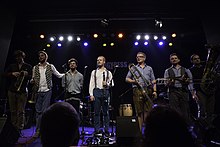
An encore at the Austrian Globe Music Awards
An encore is an boosted operation given by performers subsequently the planned show has ended, usually in response to extended adulation from the audition.[ane] Multiple encores are not uncommon, and they initially originated spontaneously, when audiences connected to applaud and demand additional functioning from the artists later on they had left the stage. Nevertheless, in modern times they are rarely spontaneous and are ordinarily a pre-planned part of the show.
Instrumental concerts [edit]
At the end of a concert, if there is prolonged applause, i more than relatively short slice may be performed as an encore. In some modern circumstances, encores have come to be expected, and artists ofttimes plan their encores. Traditionally, in a concert that has a printed set list for the audition, encores are not listed, even when they are planned. A well-known case is the operation of the Radetzky March and The Blue Danube at the end of the Vienna New year'due south Concert past the Vienna Philharmonic Orchestra; neither slice is always listed in the official programme, simply they are traditionally played every yr.[ citation needed ]
Opera performances [edit]
Beginning in the 18th century, if an aria was strongly applauded, information technology might be repeated.[ane] For example, at the premiere of Mozart's Marriage of Figaro, i May 1786, and other early performances, "many pieces were encored, nigh doubling the length of each performance".[2]
Restrictions on encores [edit]
For "Figaro", on 9 May 1786 Emperor Joseph II of Austria issued an society limiting encores.[ii]
By tradition, some earth-class opera houses, such as La Scala and the Metropolitan Opera, officially discourage encores, particularly for vocal solos, as encores were associated with less serious performances.[3] [four]
In the mid-19th century, encores were officially banned in northern Italy, since the Austrian-Italian regime felt they would lead to public disorder.[v] In 1921, encores were forbidden at la Scala (in northern Italia), considering the conductor Toscanini felt they would interrupt the footstep of the opera and drew attending to individual singers as opposed to the work.[4] Toscanini had, in 1887, been challenged to a duel afterwards stubbornly refusing an aria's encore.[6] Wagner was similarly against encores.[half-dozen]
The ban at the Metropolitan was explicit in the printed programs at the offset of the 20th century, simply was nonetheless often broken at the insistence of the audience.[seven] Encores at the Met became rarer later in the century.[3]
Pop music [edit]
In most circumstances, information technology has become standard for rock, metal, and pop artists to requite an encore; peculiarly in large settings such as stadiums and arenas. Information technology is very common for punk bands to perform an encore when in pocket-size venues. Artists oftentimes plan their encores in advance, and they are unremarkably included on the artist's setlist; one common practise is to leave one or more of their most pop songs for an encore. Withal, encores are ordinarily simply performed by the headlining artist, as opening bands almost always accept restrictions on how long their set can last, and are prohibited from going over the set time with an encore.[ commendation needed ]
Some artists include their encore as the second half of the concert. For example, the Jamaican reggae musician Bob Marley and his band The Wailers were known to play the concerts of their last 2 tours in 1979 and 1980 in 2 halves: after the start half was performed they stopped performing for some minutes to tune their instruments over again or to accept a suspension, while the audience was demanding for more. They continued to play the concert with the "encore" which lasted well-nigh an hour.[viii] Sometimes they even played one or ii additional songs (a "real" encore in the traditional sense, rather than an inevitable functioning staged as an encore) after the planned encore.[9] Similarly, former Guided past Voices frontman Robert Pollard generally plays songs from his solo career for the starting time half of his shows, and so, for the inevitable encore, will play a lengthy selection of Guided by Voices songs, with the two halves generally having roughly equal duration.[10]
In the early days of modernistic rock music, Elvis Presley never played encores, a exercise his manager Col. Tom Parker intended to leave audiences wanting more than. The now-famous phrase "Elvis has left the building" was used at the beginning of his career when Presley was not the headliner, followed by a plea for the audience to return to their seats so every bit to scout those artists following Presley. Once he became a headliner, it was invariably followed by a polite "thank you, and good dark", to imply to those present at the concert that at that place was not going to be an encore.[xi]
Jimmy Buffett is known for his intimate second encores at his concerts. He and his band leave the stage later performing their fix and render for a typical encore of usually 2 songs and ring introductions. And then they leave the stage once more and Buffett comes back out on stage past himself for a 2nd encore and performs an audio-visual ballad to end the evidence. This final vocal is usually what his hardcore fans look forward to the most because it's a different song every show and usually an obscure selection; many fans consider Buffett'south ballads to be his best songs despite not existence amongst his famous songs.[ citation needed ] A collection of Buffett's 2d encores, entitled encores, was released in 2010.
Morphine frontman Marking Sandman sometimes mocked the do. At the shut of Morphine shows, he would wave and say "Thank you! Good dark!", but the band would remain in their places, and the lights would not be dimmed. Subsequently several minutes, the band would begin playing once more.[ citation needed ]
Boston played multiple shows with four encores throughout the 1980s.[12]
Both The Cure and Prince accept been known to play a large number of songs in their encores, either in a long atypical encore or spanning across multiple encores. The encore portions of their sets have sometimes lasted longer than the initial shows themselves. The Cure have played upwardly to v encores on a scattering of occasions and Prince has played upwardly to seven.[13] [14]
Etymology [edit]
The word encore comes from the French encore [ɑ̃kɔʁ], which means 'again, some more'; still, it is not used this manner in French, only it is ancora in Italian.[fifteen] French speakers commonly use instead either une autre ('another'), un rappel ('a render, curtain call') or the Latin bis ('2d time') in the same circumstances. Italians use bis too.[15] In England, [united nations']altra volta (Italian for 'some other time') was used in the early nineteenth century, but such usage had been completely supplanted by 1900.[sixteen]
References [edit]
- ^ a b Lalange Cochrane, in Oxford Companion to Music, Alison Latham, ed., Oxford University Printing, 2002,2003
- ^ a b Solomon, Maynard (1996), Mozart: A Life, New York, HarperCollins, 1996, ISBN 0-06-019046-9, p. 304
- ^ a b Barry, Colleen (February 24, 2007). "Tenor'southward encore breaks with La Scala tradition". The Seattle Times. Archived from the original on 2014-01-04.
- ^ a b Wakin, Daniel J. (August 2008). "Ban on Solo Encores at the Met? Ban, What Ban?". The New York Times.
- ^ Parker, Roger (1997). Arpa d'or dei fatidici vati: The Verdian Patriotic Chorus in the 1840s. EDT srl. p. 23. ISBN978-88-85065-xv-4.
- ^ a b Joyce's M Operoar: Opera in Finnegans Wake . Academy of Illinois Press. 1997. p. 18. ISBN978-0-252-06557-6.
- ^ Martin, George Whitney (2003). "The Metropolitan Opera's Sunday Evening Concerts and Verdi". The Opera Quarterly. xix (1): 16–27. doi:ten.1093/oq/xix.1.16.
- ^ "Bob Marley & The Wailers Setlist at Meehan Auditorium, Brown University, Providence". setlist.fm . Retrieved 2019-07-16 .
- ^ "Bob Marley & The Wailers Setlist at Westfalenhalle i, Dortmund". setlist.fm . Retrieved 2019-07-16 .
- ^ "Robert Pollard Setlist at The Theatre of Living Arts, Philadelphia". setlist.fm . Retrieved 2019-07-16 .
- ^ Bort, Ryan (2015-01-09). "Elvis Presley and the Dying Art of Leaving Them Wanting More". Esquire . Retrieved 2019-07-16 .
- ^ "Boston Setlist at USF Dominicus Dome, Tampa". setlist.fm . Retrieved 2019-07-16 .
- ^ "The Cure Setlist at Don Haskins Center, El Paso". setlist.fm . Retrieved 2019-07-xvi .
- ^ "Prince Setlist at Festival International de Jazz de Montréal 2011". setlist.fm . Retrieved 2019-07-sixteen .
- ^ a b "encore". Oxford English Dictionary (Online ed.). Oxford University Press. (Subscription or participating institution membership required.)
- ^ "Altra Volta", in George Grove, ed., A Dictionary of Music and Musicians (1900).
Source: https://en.wikipedia.org/wiki/Encore
0 Response to "The Word for When You Want a Performance Done Again"
Post a Comment