Why Do Atoms of 7 Likely to Form With an Atom of 1 Family
Electronegativity
- Page ID
- 1496
Electronegativity is a measure of the tendency of an atom to concenter a bonding pair of electrons. The Pauling scale is the almost ordinarily used. Fluorine (the most electronegative element) is assigned a value of 4.0, and values range down to cesium and francium which are the least electronegative at 0.7.
What if ii atoms of equal electronegativity bond together?
Consider a bond betwixt two atoms, A and B. If the atoms are equally electronegative, both have the same trend to attract the bonding pair of electrons, and then information technology will exist plant on average half mode betwixt the two atoms:

To get a bond like this, A and B would unremarkably take to be the same cantlet. You lot will observe this sort of bond in, for case, H2 or Cl2 molecules. Notation: It'south important to realize that this is an boilerplate moving-picture show. The electrons are actually in a molecular orbital, and are moving around all the fourth dimension inside that orbital. This sort of bond could exist idea of equally existence a "pure" covalent bond - where the electrons are shared evenly between the 2 atoms.
What if B is slightly more than electronegative than A?
B will attract the electron pair rather more than A does.
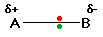
That means that the B finish of the bond has more than its fair share of electron density and so becomes slightly negative. At the aforementioned fourth dimension, the A end (rather curt of electrons) becomes slightly positive. In the diagram, "\(\delta\)" (read every bit "delta") means "slightly" - so \(\delta+\) means "slightly positive".
A polar bond is a covalent bond in which there is a separation of charge between one cease and the other - in other words in which ane end is slightly positive and the other slightly negative. Examples include well-nigh covalent bonds. The hydrogen-chlorine bond in HCl or the hydrogen-oxygen bonds in water are typical.

If B is a lot more electronegative than A, so the electron pair is dragged right over to B'south stop of the bond. To all intents and purposes, A has lost control of its electron, and B has complete control over both electrons. Ions have been formed. The bail is and so an ionic bond rather than a covalent bail.
A "spectrum" of bonds
The implication of all this is that at that place is no clear-cutting partition betwixt covalent and ionic bonds. In a pure covalent bond, the electrons are held on average exactly one-half way between the atoms. In a polar bond, the electrons have been dragged slightly towards one end. How far does this dragging have to go before the bond counts every bit ionic? There is no existent answer to that. Sodium chloride is typically considered an ionic solid, but even hither the sodium has not completely lost control of its electron. Because of the properties of sodium chloride, nevertheless, nosotros tend to count it as if information technology were purely ionic. Lithium iodide, on the other hand, would be described as being "ionic with some covalent graphic symbol". In this case, the pair of electrons has non moved entirely over to the iodine end of the bond. Lithium iodide, for case, dissolves in organic solvents like ethanol - not something which ionic substances normally do.
Summary
- No electronegativity departure between two atoms leads to a pure non-polar covalent bail.
- A small electronegativity divergence leads to a polar covalent bail.
- A large electronegativity divergence leads to an ionic bail.
Example 1: Polar Bonds vs. Polar Molecules
In a simple diatomic molecule like HCl, if the bond is polar, and then the whole molecule is polar. What about more complicated molecules?
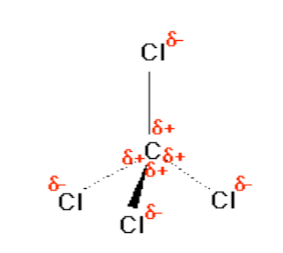

Consider CCl4, (left console in figure above), which equally a molecule is non polar - in the sense that information technology doesn't take an end (or a side) which is slightly negative and ane which is slightly positive. The whole of the outside of the molecule is somewhat negative, but there is no overall separation of charge from meridian to lesser, or from left to right.
In contrast, CHCl3 is a polar molecule (right panel in figure above). The hydrogen at the top of the molecule is less electronegative than carbon and and so is slightly positive. This means that the molecule at present has a slightly positive "top" and a slightly negative "bottom", and so is overall a polar molecule.
A polar molecule will need to be "lop-sided" in some way.
Patterns of electronegativity in the Periodic Table
The distance of the electrons from the nucleus remains relatively abiding in a periodic table row, but non in a periodic table cavalcade. The force betwixt two charges is given by Coulomb'due south law.
\[ F=chiliad\dfrac{Q_1Q_2}{r^2} \]
In this expression, Q represents a charge, k represents a constant and r is the altitude between the charges. When r = 2, then r2= four. When r = 3, so r2 = 9. When r = four, then rii = 16. It is readily seen from these numbers that, as the distance between the charges increases, the force decreases very rapidly. This is called a quadratic alter.
The result of this modify is that electronegativity increases from bottom to elevation in a cavalcade in the periodic table fifty-fifty though there are more protons in the elements at the lesser of the column. Elements at the top of a column have greater electronegativities than elements at the bottom of a given column.
The overall tendency for electronegativity in the periodic tabular array is diagonal from the lower left corner to the upper right corner. Since the electronegativity of some of the important elements cannot be determined by these trends (they lie in the wrong diagonal), we have to memorize the following guild of electronegativity for some of these common elements.
F > O > Cl > N > Br > I > S > C > H > metals
The most electronegative chemical element is fluorine. If you remember that fact, everything becomes like shooting fish in a barrel, because electronegativity must ever increase towards fluorine in the Periodic Table.
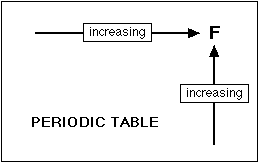
Annotation: This simplification ignores the noble gases. Historically this is considering they were believed not to course bonds - and if they do not form bonds, they cannot have an electronegativity value. Even at present that we know that some of them do form bonds, data sources nevertheless do not quote electronegativity values for them.
Trends in electronegativity across a period
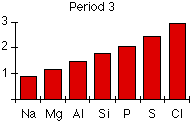
The positively charged protons in the nucleus attract the negatively charged electrons. As the number of protons in the nucleus increases, the electronegativity or attraction will increase. Therefore electronegativity increases from left to right in a row in the periodic tabular array. This effect only holds true for a row in the periodic table because the attraction between charges falls off rapidly with altitude. The chart shows electronegativities from sodium to chlorine (ignoring argon since it does non does not course bonds).
Trends in electronegativity downwardly a group
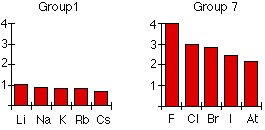
As yous go down a group, electronegativity decreases. (If it increases up to fluorine, it must decrease as you go downwardly.) The chart shows the patterns of electronegativity in Groups 1 and vii.
Explaining the patterns in electronegativity
The attraction that a bonding pair of electrons feels for a detail nucleus depends on:
- the number of protons in the nucleus;
- the distance from the nucleus;
- the corporeality of screening by inner electrons.
Why does electronegativity increase across a period?
Consider sodium at the beginning of period 3 and chlorine at the terminate (ignoring the element of group 0, argon). Think of sodium chloride as if information technology were covalently bonded.
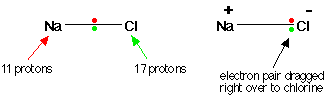
Both sodium and chlorine have their bonding electrons in the 3-level. The electron pair is screened from both nuclei by the 1s, 2s and 2p electrons, simply the chlorine nucleus has 6 more protons in it. It is no wonder the electron pair gets dragged so far towards the chlorine that ions are formed. Electronegativity increases beyond a period because the number of charges on the nucleus increases. That attracts the bonding pair of electrons more strongly.
Why does electronegativity fall as you go downwards a grouping?
As y'all go downwards a group, electronegativity decreases because the bonding pair of electrons is increasingly afar from the attraction of the nucleus. Consider the hydrogen fluoride and hydrogen chloride molecules:
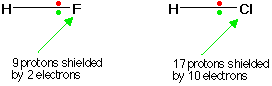
The bonding pair is shielded from the fluorine's nucleus simply by the 1s2 electrons. In the chlorine case information technology is shielded past all the 1s22s22phalf dozen electrons. In each case there is a cyberspace pull from the center of the fluorine or chlorine of +seven. But fluorine has the bonding pair in the 2-level rather than the 3-level as it is in chlorine. If it is closer to the nucleus, the attraction is greater.
Diagonal relationships in the Periodic Table
At the beginning of periods two and iii of the Periodic Tabular array, there are several cases where an element at the top of one grouping has some similarities with an element in the side by side grouping. Three examples are shown in the diagram below. Observe that the similarities occur in elements which are diagonal to each other - non side-past-side.
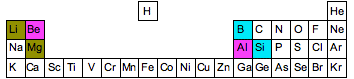
For example, boron is a non-metal with some properties rather similar silicon. Unlike the rest of Group 2, beryllium has some properties resembling aluminum. And lithium has some properties which differ from the other elements in Group ane, and in some ways resembles magnesium. There is said to exist a diagonal relationship between these elements. There are several reasons for this, simply each depends on the way atomic properties like electronegativity vary effectually the Periodic Table. Then nosotros will have a quick look at this with regard to electronegativity - which is probably the simplest to explain.
Explaining the diagonal human relationship with regard to electronegativity
Electronegativity increases across the Periodic Table. And then, for example, the electronegativities of beryllium and boron are:
Electronegativity falls as you become down the Periodic Tabular array. So, for example, the electronegativities of boron and aluminum are:
So, comparing Be and Al, you observe the values are (by risk) exactly the same. The increase from Group 2 to Grouping 3 is offset by the autumn every bit you go downward Grouping iii from boron to aluminum. Something similar happens from lithium (1.0) to magnesium (1.ii), and from boron (2.0) to silicon (i.8). In these cases, the electronegativities are not exactly the aforementioned, just are very close.
Similar electronegativities between the members of these diagonal pairs ways that they are probable to class like types of bonds, and that will impact their chemistry. Y'all may well come across examples of this afterwards on in your class.
Contributors and Attributions
-
Jim Clark (Chemguide.co.great britain)
- Prof. Richard Bank, Boise Land University, Emeritus,
Source: https://chem.libretexts.org/Bookshelves/Physical_and_Theoretical_Chemistry_Textbook_Maps/Supplemental_Modules_%28Physical_and_Theoretical_Chemistry%29/Physical_Properties_of_Matter/Atomic_and_Molecular_Properties/Electronegativity
0 Response to "Why Do Atoms of 7 Likely to Form With an Atom of 1 Family"
Post a Comment